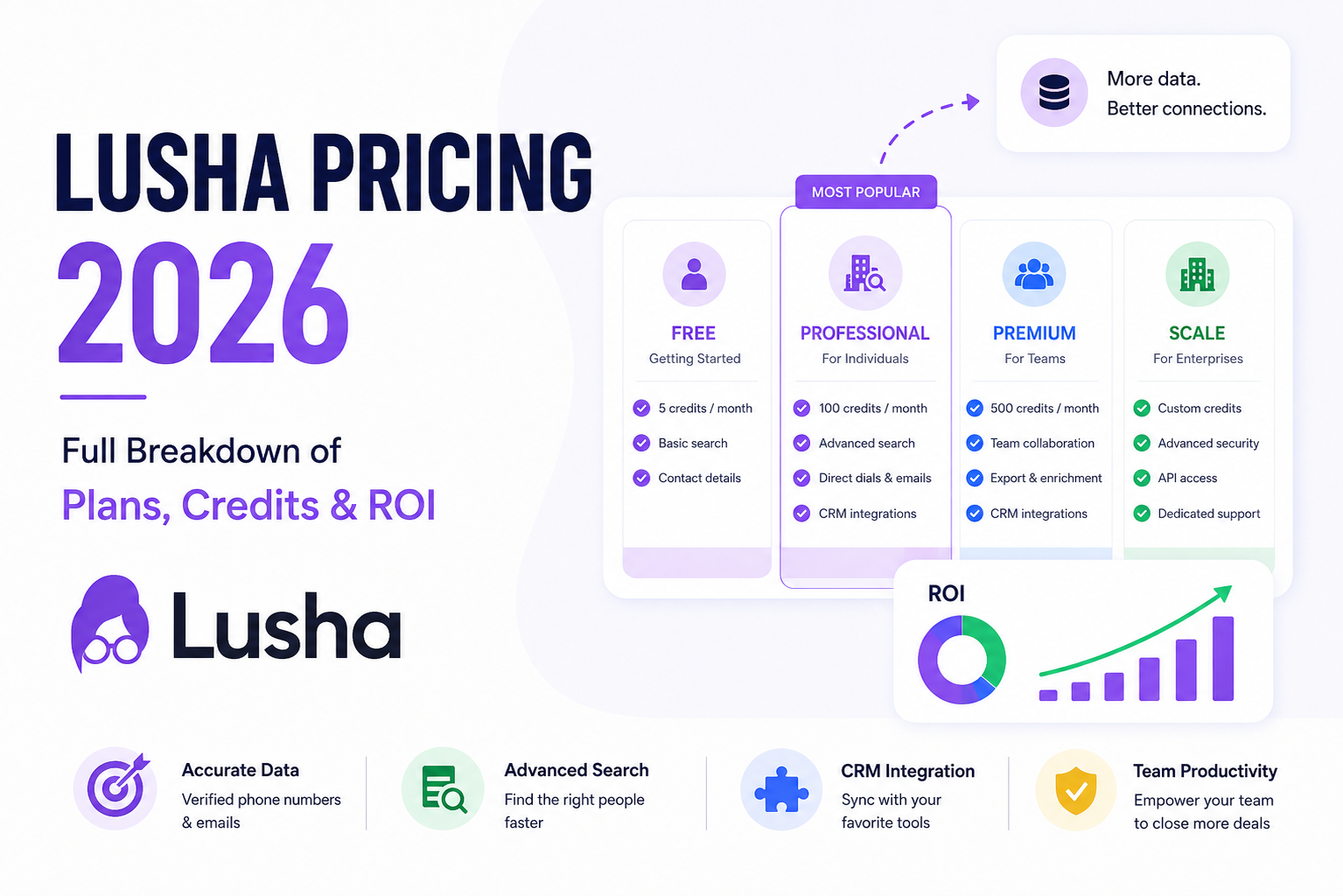
Lusha Pricing Guide 2026: Plans and Costs Explained

keyKey Takeaways
Accurate contact data is essential for modern sales and recruitment success
This guide provides a transparent breakdown of 2026 subscription tiers
I aim to help professionals align their budget with specific outreach goals
Understanding platform costs allows for better long-term financial planning
The analysis focuses on helping you choose the most effective intelligence tools
In today’s fast paced sales and recruitment environment, data accuracy is the foundation of every successful outreach strategy. As I analyze the current market, I recognize that choosing the right contact intelligence tool requires a clear understanding of the financial commitment involved.
This guide serves as your primary resource for navigating lusha pricing in 2026. My goal is to provide a transparent overview of how the platform structures its costs to help you make an informed decision for your team.
Effective outreach relies on high-quality information that connects you with the right prospects at the right time. By breaking down the available subscription tiers, I will help you evaluate which plan aligns best with your specific business needs. Understanding this pricing model ensures you maximize your return on investment while leveraging the full power of the lusha ecosystem.
Understanding the Value Proposition of Lusha
My experience shows that the cost of poor data far outweighs the initial investment in a high-quality platform. When I look at lusha pricing, I see it as a strategic investment rather than a simple expense. The platorm provides direct access to decision-makers, which is the lifeblood of any successful sales team.
The core value of this tool lies in the accuracy and accessibility of its B2B contact data. Unlike cheaper alternatives that often provide outdated or generic information, this service focuses on verified phone numbers and professional email addresses. This precision allows my outreach efforts to reach the right person on the first attempt.
"Data is the new oil, but only if it is refined and actionable. Without high-quality contact information, even the best sales strategy will fail to gain traction."
When analyzing lusha pricing, I consider the time saved by my team. Instead of spending hours manually searching for valid contact details, my representatives can focus on building relationships and closing deals. This shift in productivity directly contributes to a higher return on investment for the business.
Companies often choose this platform because it delivers high-intent data that drives results. While the market offers lower-cost options, the lack of reliability in those tools frequently leads to wasted time and missed opportunities. By balancing the cost against the quality of leads, I find that the current lusha pricing structure remains competitive for teams that prioritize efficiency and growth.
A Deep Dive into Lusha Pricing Structures
My goal here is to demystify the complex layers of lusha pricing so you can make an informed decision for your team. I have found that the platform uses a modular approach to ensure that users only pay for the specific data access they require. This architecture is designed to support everyone from independent consultants to large, global sales departments.
When you evaluate your options, you must first consider the billing cycle. Choosing an annual plan typically results in significant cost savings compared to a month-to-month commitment. This strategic choice allows businesses to lock in their budget while securing a steady stream of contact credits for their outreach efforts.
The core of the lusha pricing model revolves around credit allocation. Each tier provides a set number of credits that you can use to reveal phone numbers and email addresses. I recommend tracking your usage patterns closely, as these credits are the primary currency within the platform's ecosystem.
To help you visualize how these tiers align with different organizational needs, I have compiled the following breakdown of the structural differences:
Plan Tier | Target Audience | Billing Flexibility | Credit Management |
Free | Individual Starters | N/A | Limited Monthly |
Pro | Solo Professionals | Monthly or Annual | Fixed Monthly |
Premium | Growing Teams | Monthly or Annual | Shared Pool |
Scale | Large Enterprises | Annual Contracts | Customized Volume |
Understanding these segments is vital for long-term success. By aligning your specific needs with the right lusha pricing tier, you ensure that your team maintains a consistent workflow without overspending on unnecessary features. Careful planning at this stage prevents the need for frequent plan adjustments as your company expands.
Analyzing the Free Plan and Its Limitations
I often recommend the free plan for those who want to explore contact intelligence without an upfront financial commitment. This tier acts as a testing ground for your sales team to verify the quality of the data provided by the platform. When you consider lusha pricing, it is helpful to see this version as a trial rather than a long-term solution for high-volume outreach.
The primary limitation of the free tier involves the credit count. You receive a very small number of credits each month, which restricts your ability to perform large-scale prospecting. Once you exhaust these credits, you must wait for the next cycle or upgrade your account to continue accessing contact information.
Furthermore, the free version lacks the advanced features found in higher tiers. You will miss out on bulk export capabilities and advanced CRM integrations that are essential for scaling your operations. If your goal is to build a robust pipeline, you will likely find that the free version is only sufficient for initial testing. Evaluating lusha pricing requires you to weigh these restrictions against your actual lead generation needs.
Feature Category | Free Plan Access | Paid Plan Access |
Monthly Credits | Limited (Trial) | High Volume |
CRM Integration | Not Available | Full Support |
Bulk Export | Restricted | Included |
Support Level | Standard | Priority |
Breakdown of the Pro Plan for Individual Users
When I evaluate lusha pricing, the Pro plan stands out as a dedicated solution for independent sellers and small business owners. This tier is designed specifically for those who need to move beyond the limitations of a free account to achieve consistent results. It provides the necessary infrastructure to professionalize your daily outreach efforts.
The Pro plan unlocks several essential tools that help you identify and connect with high-quality prospects more efficiently. By upgrading, you gain access to features that streamline your workflow and save valuable time during your prospecting phase.
Advanced search filters: Narrow down your target audience by industry, company size, and specific job titles.
CRM integration: Seamlessly sync your contact data directly into platforms like Salesforce or HubSpot.
Increased credit limits: Access a higher volume of contact information to fuel your sales pipeline.
I often consider whether the cost of this subscription is justified by the potential increase in lead conversion. For many individual users, the ability to reach the right decision-maker faster often leads to a higher return on investment. When you analyze lusha pricing, it is helpful to view the Pro plan as a scalable asset rather than just an expense.
Investing in this tier allows you to build a more predictable sales process. As your business grows, the transition from manual searching to integrated data management becomes a critical step in your professional development. Choosing the right plan now ensures you have the support needed to scale your outreach effectively.
Evaluating the Premium Plan for Growing Teams
My analysis of the Premium plan shows it is designed specifically for teams that need to work together efficiently. As your sales or recruitment department grows, managing individual accounts becomes a logistical burden. This tier simplifies your operations by centralizing control under one roof.
When you look at lusha pricing for this level, you gain access to powerful collaborative features. These tools allow your staff to stay aligned while pursuing shared goals. By moving away from fragmented accounts, you ensure that your data remains consistent across the entire organization.
The Premium plan introduces several essential benefits for scaling businesses:
Shared credit pools that allow team members to pull from a single resource bank.
Advanced team management features to oversee user activity and permissions.
Enhanced reporting tools that provide deep insights into your team's outreach performance.
I often recommend this tier because it offers superior cost-efficiency compared to managing multiple individual Pro subscriptions. You avoid the administrative overhead of paying for separate licenses while gaining better visibility into your usage patterns. This makes the overall lusha pricing structure much more predictable for finance departments.
Ultimately, this plan acts as a bridge between small-scale operations and enterprise-level needs. It provides the structure necessary to maintain high productivity as your headcount increases. By investing in these collaborative tools, you position your team for long-term success in a competitive market.
Customizing the Scale Plan for Enterprise Needs
I find that the Scale plan serves as the ultimate solution for businesses demanding high-level customization. When your organization reaches a certain size, standard subscription tiers often fail to meet your complex operational requirements. This is where the lusha pricing model shifts from a fixed cost to a bespoke agreement tailored to your specific goals.
Large enterprises require more than just basic access; they need a robust infrastructure that supports global teams. By opting for the Scale plan, you gain access to a suite of tools designed for high-volume data consumption. Key features typically included in this tier are:
Dedicated Account Management: Receive personalized support to ensure your team maximizes platform utility.
Advanced API Access: Integrate data directly into your existing CRM or internal workflows seamlessly.
Enterprise-Grade Security: Benefit from enhanced compliance protocols and data governance features.
I often explain to decision-makers that the lusha pricing for this tier is rarely static. Instead, costs are negotiated based on your unique volume requirements and the overall complexity of your organizational structure. This flexibility allows you to pay for exactly what you need without overextending your budget on unnecessary features.
"True enterprise value is found in the ability to scale your tools alongside your business growth, ensuring that every dollar spent contributes directly to your bottom line."
Moving to an enterprise-grade solution provides a strategic advantage in competitive markets. By aligning your data strategy with a customized plan, you ensure that your sales and marketing teams have the most accurate information available. Ultimately, the lusha pricing structure for the Scale plan is designed to foster long-term partnerships rather than simple transactional relationships.
Key Features Included Across Different Tiers
When evaluating lusha pricing, it is vital to map specific features to your actual daily workflow needs. I believe that understanding the feature set across different tiers is the best way to ensure you get the most value from your investment. By identifying which tools are essential versus those that are merely nice to have, you can avoid paying for unnecessary extras.
At the entry level, the focus remains on basic contact discovery. This allows users to find verified phone numbers and email addresses for their prospects. As you move up the subscription ladder, the platform unlocks more sophisticated capabilities. These advanced features often include bulk enrichment, which saves significant time for teams managing large databases.
"The true power of a sales intelligence platform lies not in the volume of data, but in the precision of the intent signals that guide your outreach strategy."
Higher tiers also introduce intent data, a powerful tool for identifying companies actively searching for solutions like yours. While these features are impressive, they may not be necessary for every individual user. My goal is to help you visualize how these tools scale alongside your business growth, ensuring your lusha pricing remains aligned with your actual revenue goals.
Feature Category | Free/Pro Tier | Premium/Scale Tier | lusha pricing Impact |
Contact Discovery | Standard Access | Unlimited Access | Baseline Cost |
Bulk Enrichment | Limited | Full Integration | Tiered Increase |
Intent Data | Not Included | Advanced Analytics | Premium Investment |
CRM Integration | Basic | Advanced/Custom | Enterprise Value |
Ultimately, selecting the right plan requires a careful balance between current needs and future scalability. I recommend starting with a clear list of your team's must-have features before committing to a higher tier. This strategic approach ensures that your budget is spent on tools that directly contribute to your sales success.
Hidden Costs and Add-on Expenses to Consider
While the base subscription fee is straightforward, I often find that users overlook secondary expenses that can impact their bottom line. When evaluating lusha pricing, it is vital to look beyond the initial monthly or annual commitment to ensure your budget remains stable.
One common area where costs can climb involves overage fees. If your team exceeds the allocated credit limit for contact discovery, you might face unexpected charges. I recommend setting up internal alerts to monitor your usage patterns throughout the month to avoid these surprises.
Another factor to consider is the cost of adding new team members. Most plans are structured per seat, meaning that scaling your sales department requires a proportional increase in your lusha pricing structure. You should also account for potential add-ons, such as advanced integrations or specialized data enrichment services, which may not be included in your base tier.
To maintain a transparent financial outlook, I suggest reviewing your usage dashboard regularly. By tracking how many credits your team consumes weekly, you can better predict when you might need to upgrade your plan or purchase additional credits. This proactive approach helps keep your total cost of ownership predictable and manageable.
Expense Category | Description | Impact on Budget |
Overage Fees | Exceeding monthly credit limits | Variable/High |
Additional Seats | Adding new users to the account | Fixed/Predictable |
Premium Integrations | Advanced CRM or API access | Fixed/Add-on |
Data Enrichment | Bulk data processing services | Variable/Medium |
Comparing Lusha Against Competitors in the Market
When evaluating sales intelligence tools, I often find that comparing lusha pricing to other market leaders reveals significant differences in data quality. While some platforms offer lower entry points, they often sacrifice the depth and verification standards that define a premium service. I view this as a classic trade-off between immediate budget savings and long-term prospecting efficiency.
Many users wonder why they should pay a premium when cheaper alternatives exist. The answer usually lies in the accuracy of the contact information. High-quality data reduces the time your team spends on dead-end leads, which ultimately saves money in the long run.
"Price is what you pay. Value is what you get."
To help you visualize how these platforms differ, I have compiled a comparison based on general market positioning. While lusha pricing is competitive, it is important to look at what you receive for your investment compared to others.
Platform | Data Focus | Market Position |
Lusha | High Accuracy | Mid-Market/Enterprise |
Volume/Scale | Budget-Friendly | |
ZoomInfo | Broad Coverage | Enterprise/Premium |
When I analyze the landscape, I notice that lusha pricing reflects a commitment to providing verified, actionable contact details. Competitors focusing on massive volume often struggle with outdated records, which can frustrate sales representatives. If your goal is to maintain a clean CRM, the investment in a more specialized tool is usually worth the extra cost.
Ultimately, your choice should align with your specific sales goals. If you prioritize precision over sheer quantity, you will likely find that the cost structure of this platform provides a superior return on investment. Always consider the hidden costs of bad data before settling for a cheaper, less reliable alternative.
Pros and Cons of the Current Subscription Model
When I analyze the current subscription model, I see both clear benefits and specific challenges for users. Understanding lusha pricing is essential because it directly influences how your sales team accesses contact information. I believe that transparency in these costs helps businesses plan their outreach strategies more effectively.
The primary advantage of this model is its flexibility. You can scale your access as your team grows, ensuring that you only pay for the seats you actually need. This modular approach allows startups and established firms alike to maintain control over their monthly expenses.
"The true value of a data platform lies not just in the cost, but in the quality of the connections it enables for your sales pipeline."
However, I must also point out some potential pain points. One common concern involves credit expiration, which can feel restrictive if your team has fluctuating lead generation needs. Additionally, the seat-based structure might become expensive if you have a large team that requires constant access to the platform.
To help you weigh your options, consider these factors:
Pros: High-quality data accuracy, scalable tiers, and user-friendly interface.
Cons: Credit limits, potential for unused seats, and rigid contract terms.
Ultimately, lusha pricing requires a careful look at your internal workflows. If your team uses the platform daily, the investment often pays for itself through saved time. If your usage is sporadic, you might find the subscription model less efficient for your specific budget constraints.
How to Choose the Right Plan for Your Business Size
Selecting the right subscription plan requires a clear understanding of your current sales velocity. I recommend starting with an audit of your team's daily prospecting habits to ensure you do not pay for features you do not use. When you analyze lusha pricing, you must prioritize the tools that directly support your revenue-generating activities.
To find the perfect fit, I suggest following this structured framework to assess your operational needs:
Evaluate Lead Volume: Calculate how many verified contacts your sales representatives need to reach out to each month.
Assess Team Size: Determine if you need individual access or a centralized dashboard for managing multiple users.
Identify Data Requirements: Decide if you need basic contact information or advanced firmographic data to qualify your prospects.
Many companies fall into the trap of over-provisioning, which leads to wasted budget on unused seats or credits. Conversely, under-provisioning can stifle your growth by limiting the number of leads your team can contact. By reviewing your lusha pricing options against your actual output, you can maintain a healthy balance between cost and performance.
I always advise my clients to look at their growth trajectory over the next six months rather than just their current state. If you anticipate a rapid expansion, choosing a scalable tier now will save you from the administrative headache of upgrading later. Aligning your subscription with your long-term business goals is the most effective way to ensure a high return on your investment.
Ultimately, the best choice is one that scales alongside your success. Take the time to map your specific data needs to the available tiers to avoid unnecessary expenses. A thoughtful approach to lusha pricing ensures that your resources remain focused on what matters most: closing deals and growing your revenue.
Maximizing Your Return on Investment with Lusha
I believe that maximizing your return on investment starts with how you utilize your chosen plan. Even if you select a basic lusha pricing tier, you can achieve high-level results by focusing on smart data habits. My goal is to help you turn your subscription into a powerful engine for business growth.
First, prioritize data hygiene within your CRM. Regularly cleaning your contact lists ensures that you only spend credits on accurate, high-quality information. This simple step prevents wasted resources and keeps your outreach efforts focused on real prospects.
Next, master the use of advanced search filters to narrow your target audience. By applying specific firmographic and demographic criteria, you avoid burning through your monthly allowance on irrelevant leads. This precision is essential for keeping your effective cost per lead low while maintaining high conversion rates.
Integrating the platform directly into your existing CRM workflow is another game-changer. When you automate the transfer of contact data, you save hours of manual entry time each week. This boost in productivity allows your team to spend more time selling and less time managing spreadsheets.
The following table outlines how specific optimization strategies directly impact your overall return on investment:
Strategy | Primary Benefit | ROI Impact |
Data Hygiene | Reduces bounce rates | High |
Advanced Filtering | Improves lead quality | Very High |
CRM Integration | Saves manual labor | High |
Lusha Pricing Review | Aligns costs with usage | Medium |
By consistently applying these best practices, you ensure that your lusha pricing investment pays off. Focus on efficiency, and you will see your outreach efforts translate into measurable success for your business.
Common Mistakes When Selecting a Lusha Subscription
Many companies fall into the trap of picking a plan based solely on current needs rather than future growth. I often see teams prioritize immediate savings while ignoring the long-term lusha pricing implications of their choice. This short-sighted approach frequently leads to buyer's remorse when your team outgrows its limits during a critical sales quarter.
Another frequent error involves failing to account for team expansion. If you lock into a rigid tier without considering how your headcount might change, you may face unexpected upgrade costs. It is vital to project your hiring goals before committing to a specific contract length or user limit.
I recommend evaluating your data usage patterns carefully to avoid paying for features you do not actually use. Miscalculating your volume requirements often results in wasted budget that could have been allocated elsewhere. By analyzing your historical lead generation needs, you can make a more informed decision regarding lusha pricing and service tiers.
The following table highlights the difference between reactive and proactive planning when selecting your subscription:
Selection Factor | Reactive Approach | Strategic Approach |
Scalability | Ignores future growth | Plans for team expansion |
Budgeting | Focuses on lowest cost | Focuses on total ROI |
Lusha Pricing | Static and rigid | Flexible and tiered |
Feature Usage | Over-purchasing tools | Aligns tools with needs |
Ultimately, avoiding these common pitfalls ensures that your investment remains sustainable. Taking the time to map out your requirements today prevents the headache of mid-contract adjustments. Always prioritize long-term value over temporary discounts to keep your sales engine running smoothly.
Conclusion
Selecting the right subscription requires a clear understanding of your current sales goals and team size. I recommend auditing your lead generation needs before committing to a specific tier. This approach ensures you get the best value from your investment.
My analysis of lusha pricing highlights that the most effective strategy involves matching features to your actual workflow. You should prioritize tools that directly impact your conversion rates. Small teams often find success with entry-level options, while larger organizations benefit from the robust capabilities found in enterprise tiers.
Reviewing your budget against the available lusha pricing options helps prevent overspending on unused features. I suggest starting with a plan that meets your immediate requirements. You can always scale your subscription as your business grows and your data needs expand.
Take a moment to evaluate your team's performance metrics today. Aligning your software choices with your long-term vision creates a sustainable path for growth. Reach out to the support team if you need help navigating the specific nuances of your chosen plan.
Frequently Asked Questions
Level up your LinkedIn game
Join 15,000+ professionals receiving weekly LinkedIn algorithm deep-dives.
Explore Core Workspaces
Level up your personal brand with specialized growth tools.
AI Hook Generator
Stop letting users scroll past your ideas. Generate high-converting hooks that trigger immediate curiosity and drive profile visits.
Visual Calendar Queue
Schedule weeks of LinkedIn updates in under an hour. Plan, sequence, and automatically queue drafts in one visual drag-and-drop board.
Video Downloader
Save, study, and remix high-performing professional video content. Save high-resolution MP4 clips to your creator assets folder instantly.