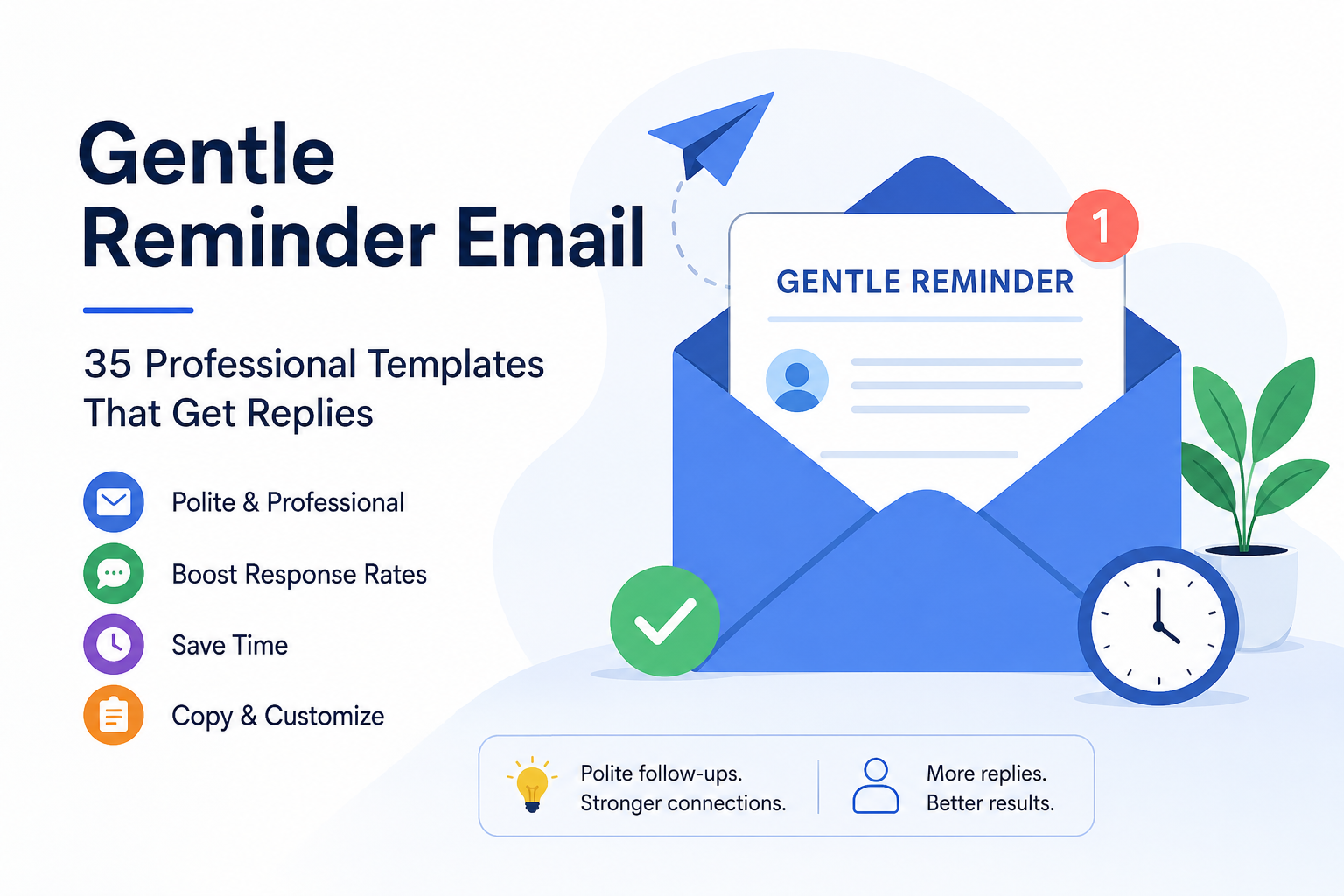
Gentle Reminder Email Tips for Polite and Effective Follow‑Up

keyKey Takeaways
Prioritize clarity and brevity to respect the recipient's time.
Maintain a friendly tone to preserve long-term professional connections.
Choose the right timing to increase the likelihood of a response.
Focus on providing value rather than just demanding an update.
Use clear subject lines to ensure your message gets noticed quickly.
I know how frustrating it feels when a project stalls because you are waiting for a response. Mastering the art of the gentle reminder email is essential for keeping your professional relationships healthy and productive.
A well-crafted follow-up acts as a bridge between silence and a successful conversation. My goal is to help you navigate these interactions so you appear helpful rather than pushy.
When you approach your outreach with empathy, you increase your chances of getting a prompt reply. This guide serves as a comprehensive resource for anyone looking to improve their communication strategy. By using a gentle reminder email, you ensure your requests remain respectful while still achieving your desired results.
Understanding the Psychology of the Follow-Up
Professional communication is often more about psychology than it is about the actual words on the screen. When I send a message, I often find myself questioning the silence that follows, but I have learned that non-response is rarely a personal slight. By viewing the situation through an objective lens, I can craft a gentle reminder email that respects the recipient's time while keeping my project moving forward.
Why People Forget to Reply
In our fast-paced digital world, even the most organized professionals struggle with an overflowing inbox. Most people do not ignore messages out of malice; they simply get buried under a mountain of tasks. Cognitive overload is a real phenomenon that causes important emails to slip through the cracks of a busy workday. When a recipient sees a notification, they might intend to reply later, only to be interrupted by an urgent meeting or a phone call. By the time they return to their screen, the message has moved down the list. Recognizing this reality helps me stay patient and professional when I need to send a gentle reminder email to nudge them back to the conversation.
The Fine Line Between Persistence and Annoyance
Finding the balance between being helpful and being a nuisance is a skill that takes practice. I always remind myself that my goal is to facilitate progress, not to pressure the other person. Empathy is the key ingredient that prevents a follow-up from feeling like an intrusion. If I approach the situation with a collaborative spirit, my outreach feels like a helpful nudge rather than a demand. A well-timed gentle reminder email serves as a bridge to reconnect, provided it remains polite and concise. Staying mindful of the recipient's perspective ensures that my persistence is viewed as a sign of dedication rather than an annoyance.
Preparing Your Mindset Before You Send
I have found that the most successful follow-ups begin long before the email is sent. Before I draft a gentle reminder email, I take a moment to center my thoughts and ensure my intentions are clear. This mental preparation helps me remain calm and professional, even if the recipient has been silent for a while.
Managing Your Expectations
It is easy to feel frustrated when a message goes unanswered, but I remind myself that everyone is juggling competing priorities. I try to view the lack of a response as a reflection of the recipient's busy schedule rather than a personal slight. Maintaining this perspective allows me to approach the situation with empathy instead of irritation.
"Patience is not the ability to wait, but the ability to keep a good attitude while waiting."
By keeping my expectations realistic, I avoid the trap of sounding demanding. I focus on the value I am providing rather than the speed of the reply. This shift in focus makes my gentle reminder email feel like a helpful nudge rather than a burden.
Choosing the Right Time to Reach Out
Timing is a critical factor in whether your message gets read or ignored. I generally avoid sending follow-ups during high-stress periods, such as early Monday mornings or late Friday afternoons. Instead, I look for windows where the recipient is likely to have the mental space to process my request.
To maximize my chances of success, I consider these factors:
Mid-week timing: Tuesday through Thursday often yields the highest response rates.
Time zone awareness: I ensure my gentle reminder email arrives during the recipient's local business hours.
Project milestones: I try to align my outreach with natural breaks in their workflow.
By choosing the right moment, I show respect for the recipient's time. This thoughtful approach significantly increases the likelihood of receiving a positive and timely reply.
Crafting the Perfect Subject Line
Your subject line acts as the digital handshake for your follow-up message. It is the very first thing a recipient sees, and it dictates whether your email gets opened or buried in a crowded inbox. I find that a well-crafted gentle reminder email significantly increases the likelihood of a prompt response.
Keeping It Clear and Concise
When I write a follow-up, I prioritize brevity above all else. A subject line should be short enough to read on a mobile device without being cut off. I aim for five to seven words that clearly state the purpose of my message. Avoid using vague terms like "Checking in" or "Hello." Instead, be direct and professional to show that you respect the recipient's time. A clear subject line helps the reader understand exactly what you need before they even click.
Using Context to Jog Their Memory
I often include a specific reference to our previous conversation to help the recipient recall the context immediately. By mentioning a project name or a specific date, I save them the trouble of searching through old threads. This approach makes your gentle reminder email feel like a helpful nudge rather than an interruption.
"The art of communication is the language of leadership."
— James Humes
Consider the following table to see how small adjustments can improve your open rates:
Ineffective Subject | Effective Subject | Why It Works |
|---|---|---|
Checking in | Follow-up: Q3 Marketing Proposal | Provides specific context |
Any update? | Update regarding Project Alpha | Clear and professional |
Hello again | Gentle reminder email: Design feedback | Sets a friendly, clear tone |
By using these strategies, you ensure your professional outreach remains both polite and effective. Always aim to provide enough information so the recipient knows exactly what to expect when they open your message.
Structuring Your Gentle Reminder Email
I find that the best way to handle a follow-up is to build it like a bridge between your past request and your current goal. A well-organized gentle reminder email acts as a helpful nudge rather than a demand for attention. By following a logical flow, you ensure that your recipient can process your request quickly and efficiently.
Opening with a Friendly Greeting
The foundation of any successful message is a warm and inviting start. I always recommend using a professional yet approachable greeting to set a positive tone immediately. Starting with a smile in your writing helps lower the recipient's defenses and encourages a more collaborative response.
Referencing the Previous Communication
Clarity is essential when you are trying to jog someone's memory. I make it a point to briefly mention the date or the specific topic of our last interaction. This context allows the reader to identify the gentle reminder email without having to search through their entire inbox for the original thread.
Stating Your Purpose Without Pressure
It is entirely possible to be direct without sounding aggressive or impatient. I focus on stating my needs clearly while acknowledging that the recipient is likely busy. By keeping the language neutral, I avoid making the other person feel guilty for the delay, which keeps the relationship healthy and productive.
Structure Element | Effective Approach | Avoid This |
|---|---|---|
Greeting | Warm and professional | Cold or abrupt |
Context | Specific reference | Vague statements |
Tone | Helpful and light | Guilt-tripping |
Call to Action | Clear and simple | Demanding deadlines |
Using this structured approach for your gentle reminder email ensures that your communication remains professional. When you respect the recipient's time, they are much more likely to prioritize your request in their busy schedule.
Mastering the Art of Tone
When I write a follow-up, I always prioritize a tone that invites cooperation rather than demanding action. The way you phrase your message determines whether the recipient feels supported or pressured. A gentle reminder email should serve as a bridge to progress, not a source of friction.
Avoiding Passive-Aggressive Language
It is easy to let frustration slip into your writing when you are waiting for a response. However, using phrases like "as I mentioned before" or "per my last email" often comes across as condescending. These subtle jabs can damage your professional reputation and make the recipient defensive. I find that avoiding these traps is crucial for keeping the conversation moving forward. Instead of highlighting the other person's delay, focus on the project's needs. Clear and neutral language is always more effective than sarcasm or thinly veiled impatience.
Maintaining a Helpful and Collaborative Vibe
To ensure your message is received well, adopt a partnership-oriented mindset. I try to frame my requests as a way to help the recipient stay on track with their own goals. This approach transforms a gentle reminder email into a supportive nudge rather than a demand. You can achieve this by offering assistance or asking if there is anything you can do to simplify the process. When you position yourself as a collaborator, you build stronger professional connections. A gentle reminder email that emphasizes teamwork will almost always yield better results than one that focuses solely on your own timeline.
Best Practices for Timing Your Follow-Up
I have found that the success of a gentle reminder email often hinges on the specific moment it lands in an inbox. Sending a message too early can feel pushy, while waiting too long might cause your request to lose its urgency. Finding that sweet spot requires a blend of patience and professional awareness.
Determining the Ideal Waiting Period
In most professional settings, waiting three to five business days is the standard rule of thumb. This window gives the recipient enough time to address your initial request without feeling overwhelmed by your presence. If you send a gentle reminder email too quickly, you risk appearing impatient or demanding. However, if the matter is time-sensitive, you might shorten this window to 48 hours. Always consider the nature of your relationship and the complexity of the task you requested. Respecting their time is the best way to ensure a positive response.
Considering Time Zones and Work Schedules
When you reach out to someone in a different region, you must account for their local time zone. Sending an email at 3:00 AM their time will likely bury your message under a pile of morning correspondence. I always aim to have my emails arrive during the mid-morning hours, typically between 9:00 AM and 11:00 AM, when people are settled into their workday. Furthermore, avoid sending your gentle reminder email on Friday afternoons or Monday mornings. These times are often chaotic as people scramble to finish tasks or plan their week. Mid-week outreach usually yields the highest engagement rates because the recipient is in a more stable, productive flow.
Timing Strategy | Best Practice | Why It Works |
|---|---|---|
Waiting Period | 3-5 Business Days | Allows for natural workflow |
Time of Day | 9:00 AM - 11:00 AM | High focus and inbox attention |
Day of Week | Tuesday or Wednesday | Avoids weekend and Monday stress |
Common Mistakes to Avoid in Your Outreach
Sometimes, what you choose not to do is just as important as the words you include in your message. When I draft a gentle reminder email, I focus on clarity rather than volume. Avoiding common pitfalls ensures that my communication remains professional and respected by the recipient.
Over-Explaining Your Situation
One of the biggest mistakes I see is the tendency to over-explain why a follow-up is necessary. When you provide too much detail, your message can quickly become cluttered and difficult to read. Keep it simple to ensure your main point does not get lost in a sea of excuses. Over-explaining often makes a sender appear desperate or insecure about their request. Instead, I prefer to state my purpose clearly and move on. This approach shows that I respect the recipient's time and intelligence.
Sending Too Many Reminders Too Quickly
Patience is a virtue, especially when you are waiting for a response. Sending multiple messages in a short timeframe can easily damage your professional reputation. It creates a sense of pressure that often leads to the exact opposite of the desired result.
To maintain a positive relationship, I always space out my follow-ups appropriately. If you find yourself tempted to send another gentle reminder email, take a step back and wait a few more days. Here are a few key habits to avoid to keep your outreach effective:
Avoid emotional language that implies frustration or impatience.
Do not send follow-ups on consecutive days, as this feels intrusive.
Refrain from using guilt-tripping phrases that make the recipient feel bad for being busy.
Never assume the recipient is ignoring you; they are likely just managing a heavy workload.
By avoiding these common errors, you ensure that every gentle reminder email you send is viewed as a helpful nudge rather than a nuisance. Consistency and patience are the best tools in your professional toolkit.
Adapting Your Approach for Different Recipients
Adapting your outreach strategy is the secret to mastering professional correspondence. I find that tailoring my communication style is essential for getting a response, as one size rarely fits all. When I send a gentle reminder email, I always consider the specific needs and time constraints of the person on the other end.
Following Up with Busy Executives
When I reach out to high-level leaders, I prioritize extreme brevity. These individuals often manage packed schedules and appreciate messages that get straight to the point. I ensure my gentle reminder email highlights the value proposition immediately so they can make a quick decision. Respecting their time is the best way to maintain a positive relationship. I avoid long paragraphs and instead use bullet points to summarize the key information. This approach shows that I value their focus and professional bandwidth.
Reaching Out to Potential Clients
Connecting with prospects requires a more nurturing and helpful tone. My goal is to build trust rather than just push for a sale. I frame my gentle reminder email as an opportunity to provide additional resources or answer lingering questions that might help them move forward. I focus on the specific benefits they will gain by engaging with me. By keeping the conversation centered on their needs, I increase the likelihood of a favorable response. It is important to remain patient and supportive throughout this process.
Communicating with Internal Team Members
When I work with colleagues, the tone is naturally more collaborative and casual. I still use a gentle reminder email to keep projects on track, but I keep the language friendly and team-oriented. I often reference our shared goals to remind them why our collaboration matters. Clear expectations are vital when working within a team. I make sure my request is easy to understand so that no one feels overwhelmed by the follow-up. Maintaining this balance helps me keep projects moving without causing unnecessary stress for my coworkers.
Using Templates to Streamline Your Process
Managing a high volume of correspondence often feels like a balancing act between speed and quality. I have found that relying on a well-organized library of drafts allows me to maintain high productivity without sacrificing the human touch. By leveraging a gentle reminder email, I can ensure that my follow-ups remain consistent and professional every single time.
Creating Reusable Drafts for Efficiency
Efficiency is vital in a fast-paced work environment where every minute counts. I recommend building a collection of templates that cover common scenarios, such as checking on a project status or requesting a meeting update. These drafts serve as a reliable foundation, saving me from drafting every message from scratch. When I create these templates, I focus on clarity and brevity. I ensure that the core message is easy to read while leaving room for necessary details. Having these ready-to-use snippets helps me stay organized and reduces the mental fatigue that comes with repetitive administrative tasks.
Customizing Templates for Personalization
While templates offer speed, they should never feel robotic or cold. I always make it a priority to customize each message to reflect the specific recipient and the context of our previous interaction. A generic blast often gets ignored, but a tailored note shows that I truly value the other person's time. To achieve this, I leave placeholders in my drafts for specific details like the recipient's name, a recent project milestone, or a shared interest. Adding a quick, personal observation at the start of a gentle reminder email transforms a standard template into a thoughtful communication. This simple habit ensures that my outreach feels authentic and respectful, which significantly increases the likelihood of a positive response.
Handling Non-Responses Gracefully
Navigating the silence after sending a gentle reminder email can be a delicate professional challenge. I have found that even the most well-crafted messages sometimes fail to elicit a response. Maintaining your composure during these moments is essential for preserving your reputation and long-term relationships.
Knowing When to Move On
It is vital to recognize when your persistence crosses the line into becoming a nuisance. I generally follow a three-strike rule, where I send an initial message and two follow-ups before archiving the thread. Continuing to reach out beyond this point often yields diminishing returns and may damage your professional standing. Accepting that a recipient is simply too busy or uninterested is a sign of emotional intelligence. By knowing when to step back, you save valuable time that can be better spent on other prospects. Moving on does not mean you have failed; it simply means you are respecting the other person's boundaries.
Exploring Alternative Communication Channels
If a gentle reminder email does not yield the desired result, you might consider shifting your strategy. Sometimes, a different medium can break through the digital noise that often buries standard correspondence. I often look for the recipient on professional platforms like LinkedIn to send a brief, low-pressure connection request. A quick phone call can also be highly effective if you have an established rapport with the individual. However, ensure that you choose a channel that feels appropriate for the level of your professional relationship. The goal is to remain helpful and collaborative rather than demanding.
Engagement Level | Recommended Action | Frequency |
|---|---|---|
High Interest | Personalized Phone Call | Once per week |
Moderate Interest | LinkedIn Message | Once every two weeks |
No Response | Archive and Move On | After three attempts |
Ultimately, your ability to handle non-responses with grace defines your professional character. Whether you choose to pivot your approach or move on entirely, always keep your tone polite and your intentions clear. This consistency ensures that you remain a respected contact in your industry.
Frequently Asked Questions
When is the best time for me to send a gentle reminder email?
I find that the ideal waiting period is typically three to five business days. It is crucial for me to consider the recipient’s work schedule and time zone to ensure my message doesn't get buried. For example, if I am reaching out to a contact at Google, I try to avoid their hectic Monday morning rush or Friday afternoon wind-down to increase the chances of my gentle reminder email being seen and addressed.
How can I craft a subject line that gets noticed without being pushy?
My strategy is to keep the subject line clear, concise, and context-rich. I like to include a specific reference that will jog their memory immediately, such as "Quick question regarding our Slack integration project." This approach is professional and friendly, making it easier for the recipient to identify the topic without having to search through their entire history.
What should I include in the structure of my follow-up message?
I always start with a friendly greeting to set a positive tone. Next, I briefly reference our previous communication so they have the necessary context. The core of my gentle reminder email involves stating my purpose clearly but without pressure. I make sure the message is easy to navigate, allowing the recipient to understand exactly what I am looking for without feeling overwhelmed.
How do I avoid using passive-aggressive language in my reminders?
To maintain a collaborative vibe, I steer clear of phrases like "As I mentioned before" or "Per my last email," which can come across as accusatory. Instead, I focus on being helpful and supportive. I often offer an easy way out by acknowledging how busy they must be, which helps preserve the professional relationship and keeps the conversation open and respectful.
Should I include a call to action in every reminder?
Yes, I believe a clear call to action is essential. It tells the recipient exactly what the next step is, whether it's reviewing a document in Microsoft Word or confirming a meeting time. By providing value—perhaps by attaching a helpful resource or a new insight—and giving them a specific task, I make it much simpler for them to reply and move the project forward.
Is it okay to use templates for my professional follow-ups?
I frequently use reusable drafts to improve my efficiency, but I never skip the step of personalization. Even when using a template in a tool like HubSpot, I customize the details to ensure the message feels genuine. This balance allows me to stay organized while still showing the recipient that I value our specific connection and their time.
What is the best way for me to handle a situation where there is no response?
If my gentle reminder email doesn't yield a result after a few attempts, I know it is important to handle non-responses gracefully. I might try exploring alternative communication channels, such as a brief message on LinkedIn, but I also recognize when it is time to move on. Knowing when to stop prevents me from becoming an annoyance and helps me maintain my professional composure.
Conclusion
Effective communication relies on your ability to balance persistence with genuine respect for the recipient. Sending a gentle reminder email serves as a bridge to keep your projects moving forward without creating unnecessary pressure.
I believe that the true value of these messages lies in their capacity to foster long-term professional connections. When you prioritize clarity and kindness, you show others that you value their time as much as your own.
You should view every gentle reminder email as an opportunity to reinforce your commitment to a collaborative partnership. Consistent practice helps you refine your voice and build a reputation for being both reliable and considerate.
I encourage you to apply these strategies in your daily workflow starting today. You will likely notice a positive shift in how your colleagues and clients respond to your requests. Keep refining your approach to ensure your professional interactions remain productive and meaningful.
Level up your LinkedIn game
Join 15,000+ professionals receiving weekly LinkedIn algorithm deep-dives.
Explore Core Workspaces
Level up your personal brand with specialized growth tools.
AI Hook Generator
Stop letting users scroll past your ideas. Generate high-converting hooks that trigger immediate curiosity and drive profile visits.
Visual Calendar Queue
Schedule weeks of LinkedIn updates in under an hour. Plan, sequence, and automatically queue drafts in one visual drag-and-drop board.
Video Downloader
Save, study, and remix high-performing professional video content. Save high-resolution MP4 clips to your creator assets folder instantly.